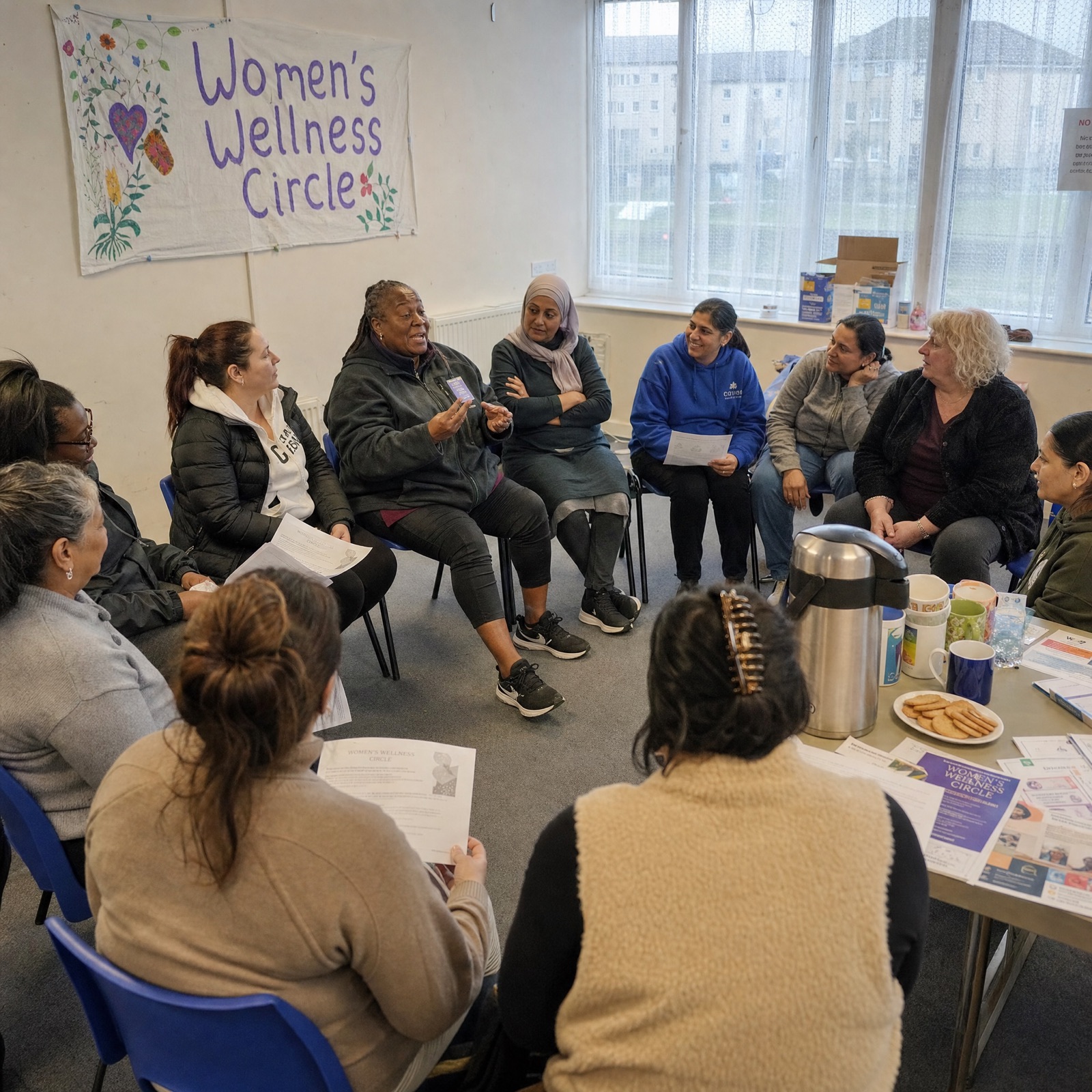
The practical work of Compass happens in living rooms, community centres, library meeting rooms, and health centre waiting areas — wherever new residents are most comfortable having honest conversations about their health. A typical week might see a navigator supporting a Polish-speaking family to understand the referral pathway for a child with suspected ADHD, another supporting a retired couple who have downsized from Edinburgh to understand what social care planning looks like in East Dunbartonshire, and a third running a Digital Health Literacy session for a group of recent arrivals from a range of countries who share only a basic level of English but a common determination to manage their own health confidently.
None of this is templated. Every conversation begins with listening. We understand that arriving in a new place — even if that place is just thirty minutes from somewhere you once knew well — involves a particular kind of disorientation that is hard to articulate and easy to underestimate. Our navigators are trained to sit with that disorientation rather than rush past it, because rushing past it is how people end up with a list of phone numbers they never call.
We also work at a systemic level. Where we see patterns — services that are repeatedly difficult to access, information that is consistently missing from official channels, populations that are not reaching us at all — we raise these issues with East Dunbartonshire HSCP, NHS Greater Glasgow and Clyde, and the Scottish Government's health inequalities team. Being embedded in Bishopbriggs means we hear things that commissioners do not, and we take seriously our responsibility to share what we learn.
Our annual State of Settlement report, published each spring, draws on anonymised data from our caseload to provide one of the most detailed pictures available of the health navigation needs of new residents in East Dunbartonshire. It is used by planners, commissioners, and voluntary sector partners across the region, and it is available to anyone who wants to understand the landscape we work in.
Each programme is designed to meet people where they are — and to leave them somewhere better.
A structured one-to-one session for anyone who has moved to Bishopbriggs within the past twelve months, covering every aspect of local health and wellbeing provision.
Delivered by a trained volunteer navigator, each session lasts approximately ninety minutes and is tailored to the household's specific circumstances — family composition, existing conditions, preferred languages, and immediate priorities. We cover GP and dental registration, pharmacy provision, mental health pathways, children's services, and the community-based wellbeing offer in East Dunbartonshire. Every participant leaves with a personalised, printed health map and a named contact at Compass they can return to with follow-up questions.
Practical, small-group workshops helping residents use NHS Scotland's digital tools confidently and independently.
Many newcomers arrive unfamiliar with Scotland's specific digital health landscape — the NHS Inform portal, the Attend Anywhere video consultation platform, or the My Health record system. Our six-week Digital Health Literacy course, run in partnership with Bishopbriggs Library and East Dunbartonshire Leisure and Culture Trust, builds these skills step by step. Participants leave able to book appointments, access repeat prescriptions, and find reliable health information online without assistance. Sessions are kept deliberately small — no more than eight participants — so that no one falls behind.
Guided weekly walks in and around Bishopbriggs that combine gentle physical activity with the social connection newcomers often need most.
Led by trained walk leaders on accessible, well-maintained routes — including the Forth and Clyde Canal towpath and Huntershill Nature Reserve — our Wellbeing Walks run every Thursday morning and Saturday afternoon. They are deliberately open to all levels of fitness and explicitly welcoming to participants who are managing long-term conditions or recovering from illness. Each walk ends at a local café where participants can continue conversations at their own pace. Several of our most enduring peer-support friendships — and a number of informal health referrals — have begun on these walks.
A structured system of tracked referrals connecting residents directly to the specific services, clinicians, and community supports they need.
Unlike a general signposting service, our Warm Referral Network involves a Compass navigator making direct contact with the receiving service on behalf of the resident, providing a brief summary of their needs, and following up within ten working days to confirm that the connection has been made. We maintain live partnership agreements with Bishopbriggs Health Centre, East Dunbartonshire HSCP, Citizens Advice East Dunbartonshire, and fourteen additional statutory and voluntary sector services. Referral outcomes are recorded and reviewed quarterly, allowing us to identify blockages in the local system and raise them with the appropriate commissioners.
If you have recently moved to Bishopbriggs and would like to book a free health orientation session, or if you would like to refer someone to our services, get in touch and we will respond within two working days.